

Whether you’re thinking of renting storage for personal purposes, such as moving house, storing sports equipment or organizing your apartment so that you have more free space, or for professional purposes, such as storing your company’s stock or some goods while you move offices, self-storage should be one of the first options you put on the table because of the flexibility, security and accessibility that characterize this concept.
The search for the ideal storage space can bring with it a number of challenges. If you’ve never been faced with the need to rent warehouses before, you may not know what technical aspects to look out for and how to prepare your search for an operator that meets your needs. In this article you’ll find the essentials of what you need to consider!
Consider how much warehouse space you need
Knowing how much space you really need is very important, not only to optimize costs, but also to promote the organization and even preservation of stored goods.
Usually, one of the most important factors when choosing a warehouse is the budget available. When the budget is smaller, there may be a tendency to rent a smaller space that is insufficient for your goods and the necessary organization, resulting in access difficulties and possible damage to the material.
On the other hand, those with a larger budget will choose to rent a larger warehouse, but often the goods they want to store don’t take up all the available space. Therefore, the best way is to make sure you rent a warehouse whose size and price ratio best meets your storage needs. But how?
Warehouse rental: take stock
Knowing exactly what you want to store is the best way to understand how much space you need. So, before you start looking for a storage unit, make a list of all the items you want to keep and, if you can, put them all together in the same space – preferably in boxes. This way, you’ll have a better idea of the dimensions you’ll need, not forgetting that you’ll probably think of more items to store.
Measure the goods to be stored
Once you have taken stock, measure the height, length and width of the objects or boxes and take their weight into account. Next, draw up a storage plan, but don’t forget that not everything can be stacked due to its weight and fragility. It will be useful to identify the most fragile items in the boxes and take this into account when organizing them in the warehouse.
Once you have in mind what you want to store and the space it takes up, it’s important to think about the square meters (length x width) or cubic meters (length x width x height) of the warehouse.
Ideally, if you want to stack your belongings, you should prefer the indications in cubic meters, but remember that overlapping objects and boxes is a good way to save space, but only if it doesn’t compromise the condition of your items.
Using boxes of a similar size is a good technique to make the whole process easier. You’ll achieve better organization and maximize the use of the available space. You’ll also be able to calculate the ratio between your goods and the self-storage unit more accurately.
When it comes to renting a warehouse, you only want to know – and pay for – the square meters you’ll be using. If you’re having trouble equating the storage space in square meters with the capacity of your goods, these tips can help:
- 1m2 – 2m2= 5 or 6 suitcases, or a fridge or bicycles, around 40 archive boxes
- 2m2 – 3m2 = contents of a single room
- 5m2 – 6m2 = furniture for three single rooms
- 9m2 – 10m2 = furniture for a 2-bedroom apartment
- 17m2 – 18m2 = furniture for a 150m2 house, the equivalent of a 4-bedroom or around 350 archive boxes

Consider the state of repair of the building
It is very important to assess the condition of the building in which you are planning to store your goods. Not all market operators take the same approach to the upkeep of the building and you should look for a credible operator who can guarantee you a structurally sound space and proper maintenance.
If warehouse spaces are not properly looked after, they can easily generate mold, putting stored goods at risk. Ask the operator about humidity levels and the regularity of maintenance and cleaning.
Don’t underestimate security
Self-storage facilities offer an essentially autonomous concept in the management of storage space. It is yours during the contracted rental period and you can organize it in the way that suits you best, as long as it does not include products or equipment that you are not allowed to store.
As a general rule, operators provide an individual access code/key. The operator will only access the space in the event of a security emergency or in the event of a breach of contract by the tenant.
Even so, it is essential to understand whether the building also benefits from its own security structure, either with human surveillance or through integrated CCTV circuits and other monitoring systems, such as burglar alarms.
The warehouse itself is usually a closed and airtight space, which is why the access key will be enough to put your mind at ease. But this industry has been developing and adapting, introducing new technologies. In some cases, you can already find personalized biometric access systems, although this is not very common, at least not yet.
Think about access
Some self-storage facilities can be massive, which in itself may not be a bad sign, as it means that the operator is strong enough in the market. But the larger the size, the more important it is to assess access to your unit.
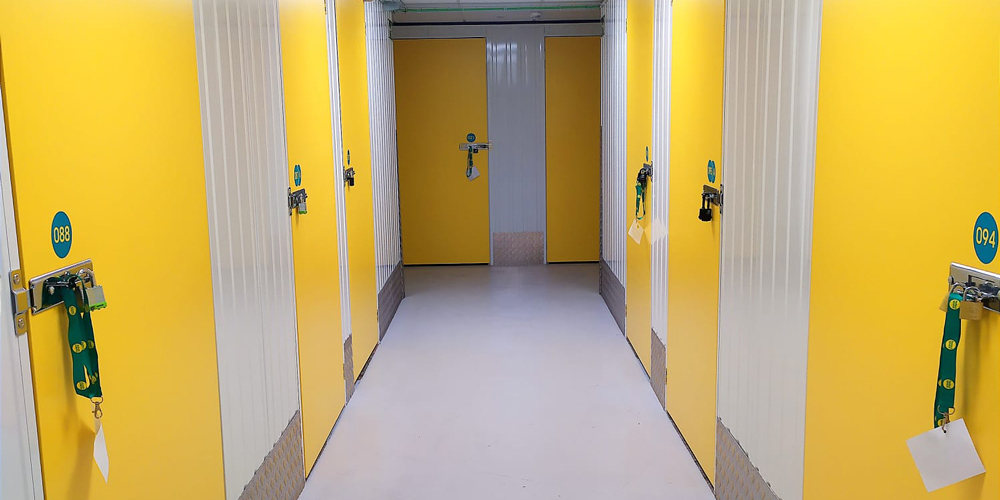
Make sure there are wide access routes with even floors, so that you can drive the trolleys with the boxes as easily as possible. The last thing you want is a labyrinthine installation that makes it difficult to transport your goods.
Also check that there is a loading and unloading area and even if there is direct access by vehicle to the door of the storage unit, as is the case, for example, at Perfect Space’s premises on Rua Júlio Dinis (Porto). Even if the facility does not have this possibility, it is important that there is parking nearby.
Choose the right location
Obviously, one of the most decisive issues when renting a warehouse is choosing a location that makes sense in logistical terms. This will depend on each specific case, but think, for example, about how often you will need to go to the warehouse.
If you have to travel frequently, you should naturally look for a closer space. As this is a long-term situation in which you won’t need to change the organization of the unit, your range of action can be extended.
Even so, ideally ensure that the warehouses are located in easily accessible areas, without major traffic constraints.
The frequency of use can also have an impact on the organization and storage of the unit. If you need to change the structure, take in new things or take out something that is already in the box, also consider some extra space for movement inside the warehouse, leaving “paths” to access the different items.
In a more static logic, you can maximize the leased space to fill it more completely and thus have an optimized cost structure.
In the case of Perfect Space, we are making an effort to diversify our locations, precisely so that we can increase our proximity to our customers.
In Porto, we already have two units in operation – Rua Júlio Dinis (near the Crystal Palace) and Rua do Paraíso (in the Lapa area). In Lisbon, we’re in Benfica and we plan to open two more warehouses in the near future, in Algés and Campo de Ourique.
Warehouse rental: understand the costs included
When you find a warehouse with the characteristics that best suit your needs, make sure you know explicitly what the rent covers. Is maintenance done by the landlord or by you? Does the space include a security system or will you have to pay for this? Is there any insurance? What does it cover?
Unlike the search for a large warehouse, where these technical issues take on a different complexity, the self storage spaces are essentially customer-oriented, offering simple and practical solutions that meet the objective needs of users.
For example, at Perfect Space you can rent a warehouse with a security system, access at any time, a place for loading and unloading, personalized service and many other advantages, including competitive prices and a promotion for new customers where the first month is free.
On the other hand, we’re talking about spaces that are very flexible in terms of the type of use they can be used for, ranging from 1m3 to 70m2 in terms of capacity, and which are also located in various areas of the country’s two main urban centers.
Consider the level of service and extras
As a final note, we also suggest that you consider the reliability and credibility of your operator. Look for companies that are well-established in the market and have a high level of service, i.e. permanent support in the event of any queries, accessible and direct contacts, simple information and a willingness to provide it, as well as clear contracts and conditions for using the spaces.
In addition, your self-storage operator can also be a key ally in helping you with certain tasks. Find out if there are any partnerships with specialized operators, for example in the area of removals. These will be entities with an established business and can relieve you of worries and uncertainties when choosing an operator, as they will already be professionally endorsed by the self storage operator.
Perfect Space ‘s spaces are available in Lisbon and, more recently, also in Porto and offer you personalized service, both on site and on location. Come andvisit us!